Pollution in the U.K.
- Jun 21, 2022
- 11 min read
Updated: Jun 23, 2022
Pollution is an issue that effects all of the countries around the world, with some being effected worse than others. Over 95% of the 7 billion people on planet Earth are breathing in polluted air which can be dangerous, this causes around 7 million deaths a year around the world. In 2015 pollution killed 9 million people worldwide which was an all time high.
What is pollution? Pollution comes from different types of substances, these can take the form of a solid, a liquid, a gas or a form of energy such as heat or sound. These substances are fed into the environment at a fast rate than it can be dispersed or recycled. There are many forms of pollution with the main 3 being;
Air Pollution - The release of chemicals and particles being pumped into the atmosphere.
Water Pollution - Industrial waste, untreated sewage and more are being thrown and spilt into our oceans and rives.
Land Pollution - Waste materials contaminating the soils both on land and underground, this can contaminate groundwater also.
Other forms of Pollution include;
Noise Pollution - Noises such as road vehicles, planes, industrial noses, machines and more are put out into the environment.
Light Pollution - The use of excessive artificial lighting around our countries.
Thermal Pollution - The rising and falling temperatures of which a body of water changes.
Smell Pollution - Any odour that can impact health such as landfills and sewage plants.
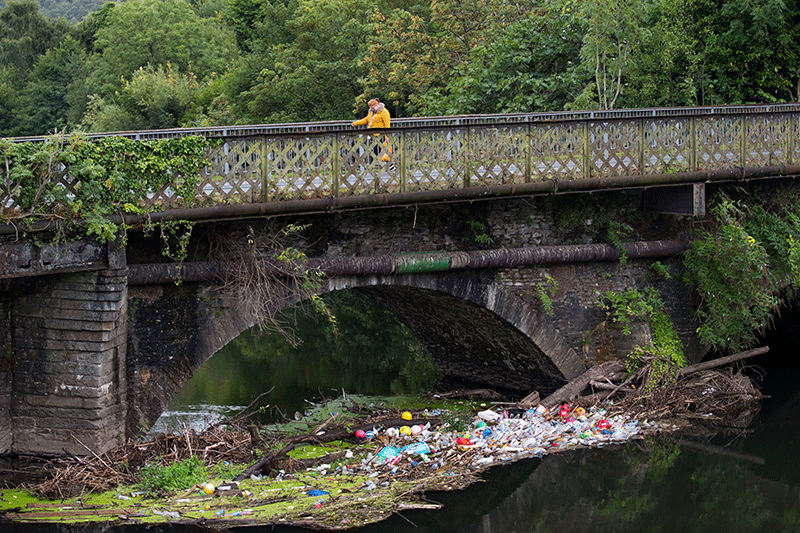
Litter Pollution - Waste materials thrown onto the ground by humans rather than disposing of them correctly can end up on our land and in our seas.
Plastic Pollution - Micro-plastics that end up in our environments and majorly impact the way of life for our wildlife and sea creatures and their habitats.




Although these are only brief descriptions, I will be talking about each individual pollution and how they effect the U.K in greater detail further below.
Today we are seeing the impacts of pollution effects more than ever. All over the news we see the icecaps melting, animals becoming extinct, global warming and climate change, sea levels rising, wildfires and so much more. Not only is pollution effecting our planet, it is also effecting human bodies around the world. In the U.K. London has one of the highest pollution rates in the country, with the pollution levels being above the legal and recommended levels. Pollution can cause asthma, lung disease, strokes, cancer and heart disease, to name a few.
The History of U.K Pollution
Pollution has been in the U.K for centuries, dating all the way back to prehistoric times when mining began, through the 1600s the growth of burning sea coal was growing and was producing foul smelling smoke across London which began causing people to suffocate. During the 1800s London was becoming the most powerful and wealthiest city in the World.
With the growing population, problems of Pollution were also growing. The U.K became the worlds leading source of carbon-based air pollution due to the coal being burnt during the industrial revolution, along side the air pollution, other types of pollution was also on the rise.
With more and more people moving to London every year a strain was put on many public services, including fresh water supple, waste disposal and the sewage systems.
1848 saw the first 'Public Health Act', this act allowed for control on sewers as well as street cleaning, public toilers and to help bring cleaner water supplies to England. Although the Public Health Act helped to a certain degree, it did not stop problems.
Each year as the weather saw hotter temperatures, smells were growing, this time of year was known as the 'summer diarrhoea'. The summer months saw millions of flies swarm the city, landing on horse manure, dead animals, sewage and rotting food left on the streets and rivers. The people most at risk were the adults and children living in the overcrowded slums, where risk of infection and diseases could spread quickly and saw hundreds of infant deaths across the city. Although London saw the major problems, this was happening around the country.
1853 saw the Smoke Nuisance Abatement Act to help control the pollution.
In the July and August of 1858, London saw one of the hottest summers to date and with the issues mentioned above, London faced a huge smell pollution issue which was named the 'The Great Stink'. During this time the new sewage system was being built and waste began to be disposed in a better way, riding the flies in the streets, although this didn't help the families living in the slums particularly.
in 1863 the Alkali Act came into place, this require the chemical industry emissions to be arrested or diluted to stop local damage to vegetation.
The industrial side of London continued to grow throughout the rest of the 1800s and well into the 1900s. After the Great Stink, Londoners faced air pollution problems regularly. With the smoke from chimneys alongside the growing motor cars on the roads, London saw what was known a 'pea soup fog' - a thick yellow, green or black fog containing soot particles and the poisonous gas known as sulphur dioxide. Fog continued to fall over London until December of 1952, when London saw the worst of the fogs it lasted for 5 days and became known as The Great Smog of 1952.
The fog fell onto Londoners and their homes and saw the deaths of up to 12000 people. Due to the cold winter weather, London was burning more coal to keep warm which resulted in air pollution levels rising. The polluting fog became trapped by the later of cold air, the fog became so thick that driving had to come to a stop due to the record-breaking low visibility in the area, it is said that pedestrians couldn't see their own feet due to the thickness.
After The Great Smog, the houses of parliament introduced the Clean Air act of 1956. A long quote from Wikipedia explains what the Clean Air act introduced;
The Clean Air Act 1956 had multiple measures to reduce air pollution. It allowed the introduction of ‘smoke control areas’ in towns and cities in which only smokeless fuels could be burned. By shifting domestic sources of heat towards cleaner coals, electricity, and gas, it reduced the amount of smoke pollution and sulphur dioxide from household fires. Reinforcing these changes, the Act also included provisions to prevent the emission of dark smoke from chimneys, required new furnaces to be smokeless, allowed local planning authorities to require higher and more effective chimneys on buildings, and required that emitted grit and dust be minimised. By prohibiting what had been the hitherto widely accepted actions of private households, the Clean Air Act 1956 had important implications for the debate about public regulation, public health, and the sphere of legitimate Government intervention
Following the Clean Air Act, the country saw many more acts come into play to help with the environmental management;
The Deposit of Poisonous Waste Act of 1972 - penalising the depositing of poisonous, noxious and polluting waste on land.
The U.K Joined the EU in 1972 and the environment law was transposed into national law from EU Directives
The Environment Protection Act of 1990 - to improve control of pollution rising from industrial provisions.
The Earth Summit of 1992 - World leaders created plans and policies to protect the environment.
The Environment Act of 1995
The Kyoto Protocol of 1997- a protocol to the United Nations Framework on Climate Change to help stabilise greenhouse gases.
The Climate Change Act of 2008 - an Act to set a target for the year of 2050 to reduce greenhouse gasses and emissions.
The Great Repeal Bill of 2019 - Preservation of EU law as the U.K leaves the EU.
In 2012, pollution levels hit an all time high in the U.K. During the year the number of deaths worldwide caused by air pollution was up at 7 million. Today the pollution levels are falling rather than rising, with the current pollution levels estimated to be roughly the same as levels around 1998.
The Big 3 Pollutions and how they effect the U.K
Air Pollution
Air pollution in the UK is the largest environmental risk to people in the country today, mainly effecting those in cities compared to those living further out in in the countryside. Air pollution in the U.K come from a mix of sources and can travel long distances away from the original source. These sources include, smoke, both from chimneys and cigarettes, burning fuels at home and in factories, emissions from power generations and vehicles, industry and farming, alongside bonfires and fireworks, to name a few. Sources can also travel from outside of the U.K such as dust travelling over from the Sahara desert in Africa, volcano smoke and pollen. Greenhouse gasses are also a source; these gasses trap heat in the atmosphere and warm the planet, which is leading to clime change. The main gases responsible for the greenhouse effect include carbon dioxide, methane, nitrous oxide, and water vapor (which all occur naturally), and fluorinated gases (which are synthetic)
The photo to the right shows where the UK is worse hit by pollution, with the highest polluted areas being in yellow, and least polluted being blue.

Current laws in the UK have the UK Government collect data each year which allows them to be able to see where they are failing to meet the legal limits for air pollution. Typically major cities in the country are above the legal pollution limit, with London being almost 2 times over that limit.
All Air Pollution reports in the UK can be found here; https://uk-air.defra.gov.uk/library/annualreport/.
Air pollution is calculated using something called 'PM', which stands for 'Particulate Matter'. These are the particles suspended in the air and are mainly made up of both solid and liquid droplets, though they can also include dust, dirt, soot and smoke. Typically these particles be categorised in PM10 and PM2.5;
PM10 : inhalable particles, with diameters that are generally 10 micrometers and smaller; and
PM2.5 : fine inhalable particles, with diameters that are generally 2.5 micrometers and smaller.
These two can be compared to other Particle Matters here, with this size comparison chart from https://www.visualcapitalist.com/visualizing-relative-size-of-particles/;

Living in these higher polluted areas can become a health concern for many,
air pollution is the top environmental risk to human health in the UK, and the fourth greatest threat to public health after cancer, heart disease and obesity. Some of the effects and illnesses people have from the pollution include; ischemic heart disease, stroke, chronic obstructive pulmonary disease, lung cancer and acute lower respiratory infections in children. Particulate air pollution has been linked with strokes, which occur when the blood supply to the brain is cut-off.
Not only do people and animals see the effects of pollution on the body, but so does the Earth - Air pollution is one of the causes for the hole in the Ozone Layer, it can damage crops and trees in many ways. As well as reductions in agricultural crop and commercial forests, reduced growth and survivability of tree seedlings, and increased plant susceptibility to disease, pests and other environmental stresses including clime change which can cause extreme weathers.
Around the world, Leaders are trying to tackle air pollution, with the U.K government having their own plans including the 'Clean Air Strategy'. As quoted by the Clean Air Stategy 2019;
Now we need to tackle other sources of air, We therefore need comprehensive action to safeguard our health.
For example, heating our homes with solid fuels makes a significant contribution to particulate matter - tiny particles that get into the lungs and blood and are transported around the body becoming lodged in the heart, brain and other organs. Like many other pollutants, particulate matter can have a short term impact over a single, highly polluted day or long-term impacts from low-level exposure over a long period of time. This strategy sets out our aim to reduce particulate matter emissions by 30% by 2020, and by 46% by 2030.
These strategies are documented and set out to protect the nations health, the environment, secure clean growth and innovation, reduce emissions from transport, homes, farming and industry and monitor the progress each year. The government are also planning to ban wholly petrol and diesel vehicles sales by 2030, they are also beginning to propose Clean Air Zones which have less traffic running through them. More examples include;
introducing a new legislation to prohibit the sale of the most polluting fuels
ensuring that only the cleanest stoves are available for sale by 2022
continuing to explore how they can give local authorities powers to increase the rate of upgrades of inefficient and polluting heating appliances
bringing existing smoke control legislation up to date, and make it easier to enforce
They are also taking action to reduce air pollution from agriculture which is responsible for 88% of ammonia emissions by:
supporting farmers to invest in infrastructure and equipment to reduce emissions
introducing regulations to require farmers to use low emission farming techniques
introducing regulations to minimise pollution from fertiliser use
Water Pollution
Water pollution in the UK comes from three main areas, overuse of fertilisers and pesticides which are used in agriculture for farming. Agriculture is responsible for around 40% of Water Pollution in the UK.

Another polluter is untreated sewage, contributing to 35% of all water pollution and finally pollutants such as oils and fuels, which are known as 'run offs'. Throughout the U.K, the highest pollution rate for water is in the South of England, particularly the South West. followed by Northern Ireland and Wales, with Scotland being lease effected. Other sources include radioactive substances, river dumping and marine dumping.
The effects of water pollution don't only effect the human race, the pollution holds toxins, micro particles, sulphate and more which soak into the environment and can effect freshwater and wetlands and wildlife, which can lead to extinction of species. Species which are now at risk include the likes of wild salmon.
In January 2022, UK Parliament put out an report discussing the water quality in the UK. They described the issue as a 'Chemical Cocktail' of the leading causes of water pollution; agriculture, plastics, chemicals and more. Many of these plastics, specifically single-use plastics, are continuing to be coated with chemicals, the chemicals are running into waters and the plastics begin to clog up drains. These issues are costing the country around £100 million per year to fix.
Continuing through 2022, the government have stated that UK water quality and pollution is a top priority. It is said that 58% of the all UKs bodies of water are impacted by pollution - with 403171 reported sewage spills in England alone.

What are the UK Government doing to help?
To help tackle water pollution caused from agriculture, the government began, in August 2021, giving farmers additional support to help lower rates. The Catchment Sensitive Farming (CSF) programme has been one of the main ways to help farmers tackle pollution The program has been given an annual budget of £30 million, which is almost double from the previous year, 2020.
Henry Pym from Higher Blindmoor Farm in Somerset, said:
“The advice from the Catchment Sensitive Farming programme and the Environment Agency has helped us better understand how to improve the water, soil and air quality around the farm. Alongside the support of CSF grants, we have been able to carry out the necessary improvements to make our practices more environmentally sustainable for the future.
“For example, herbal leys have been a real bonus as they are not only very environmentally beneficial, but also have agricultural benefits from increased intakes due to their diverse species. The herbal leys receive no artificial fertiliser which is a win-win for the farm and the environment!”
Land Pollution
Land pollution in the UK is the third leading cause of pollution in the UK. Land pollution is caused by litter and waste on the land. This includes; heavy metals, oils, chemicals, gases, asbestos, litter, home waste and more.

Similar to water pollution, one of the leading causes of land pollution is caused by agriculture. This is from farmers using pesticides and fertilisers on their crops and land, using the land to become contaminated.
None-biodegradable waste is the second leading cause. This includes landfill items such as metal, glass and plastic. These take hundreds and thousands of years to decompose. Humans littering instead of disposing of waste in the correct bins is also an issue.
Industrial waste includes chemicals, plastics, paints and other waste from industries. An example of these would include a power plant, the waste from these includes coal, woods, metals and more.
Deforestation includes cutting down trees, mining, and other activities which destroys the land. Our trees absorb 20% of the suns radiation, due to the deforestation, the radiation from the sun is going into the land, causing land pollution, soil degradation and desertification.
The mining destroys the land, and once minerals and materials have been extracted, the land is no longer usable.
Nuclear waste causes land pollution around nuclear stations and power plants.
The effects of land pollution has an ongoing effect on multiple other areas. The harmful chemicals from mining and farming can cause chemicals to go into the atmosphere, contributing to climate change and land and chemicals can cause a multitude of health problems for Earths inhabitants.
Within the U.K, more than 20000 hectors of land is contaminated (the UK is 24000000 hectors).
In 2021 when the UK left the EU, the Government issued the new Environment Act which helps support a framework to protect the envionrment. The act is to help all three of the pollutions listen above.

Comments