The Culture of the Republic of Kenya
- Jan 10, 2022
- 9 min read
KENYA

Kenya is located in Eastern Africa and has a population of over 50 million people. Though the majority of the population live in rural areas, the capital city can be found in the south-central part of the country, the city of Nairobi.
Kenya has a diverse population allowing for a wide number of languages and dialects to be found. Whilst the official language of the country is the Bantu Swahili language, English is also spoken frequently.
The countries flag can be seen above. The colour black represents the people of the Republic of Kenya, red for the blood shed during the fight for independence from the U.K and green for the country’s landscape. The white was added later to symbolise peace and honesty. In the centre is a traditional Maasai (an indigenous ethnic group) shield, the two spears symbolise the defence of all that is mentioned above.
Below you can see where Kenya is on the global map;

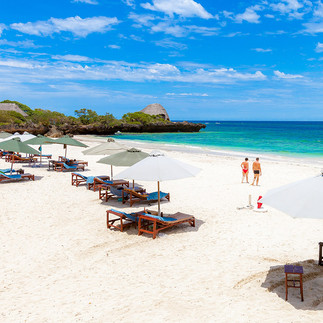
With Kenya's location, the land provides a wide variety of different environments, from the semi-arid desserts, to forests and sandy beaches of the Indian Ocean to glaciers being located on top of Mount Kenya (the mountain of which Kenya gets its name). Over the centuries Kenya has provided historical importance, the county has an Indian Ocean coast which allowed Arabian and Asian traders to enter the continent. One of the most traded items being tea.










The National Anthem
"Ee Mungu Nguvu Yetu": "O God of all Creation"
You can listen to the National Anthem below;
Although sang in Kiswahili, the English translation is as follows;
"Bless this our land and nation.
Justice be our shield and defender,
May we dwell in unity,
Peace and liberty.
Plenty be found within our borders.
Let one and all arise
With hearts both strong and true.
Service be our earnest endeavour,
And our Homeland of Kenya,
Heritage of splendour,
Firm may we stand to defend.
Let all with one accord
In common bond united,
Build this our nation together,
And the glory of Kenya,
The fruit of our labour
Fill every heart with thanksgiving."
Kenya and the Commonwealth
Kenya officially joined the Commonwealth in 1963. After gaining their independence from Britain, the country began as the Dominion of Kenya but a sovereign state, this only lasted until 1964. During the time between 1963 and 1964, Queen Elizabeth II was the sovereign of the country and ran as the countries head of state. At the end of 1964, Kenya became the Republic of Kenya and Jomo Kenyatta became the first president.

Prior to joining the Commonwealth, Africa's unclaimed territories were being claimed by people of power in Europe in the early 1880s. During this time the land that is today known as Tasmania, Kenya and Uganda, caught the eyes of Germany and Britain, in 1886 the countries signed a treaty which allowed Germany to claim the land that is present day Tasmania, and Britain the land that is Present day Kenya and Uganda.
In 1888, the British Empire formed the Imperial British East Africa Company who was founded to develop African Trade in areas controlled by the empire. In 1895, Kenya became established as the East African Protectorate by the British Empire, before the country was declared a British Colony on July 23rd 1920.
From the time the British Empire formed the Imperial British East African Company, Kenya's history was brutal and upsetting. The Kenya Human Rights Commission has said that during this time 90,000 Kenyans were executed, tortured or maimed, 50,000 of those being children and 160,000 were detained in appalling conditions.
It started when The Imperial British East African Company became bankrupt and the British government took over the administration of the colony. The British Government gave British Authorities to be able to forcibly take Kenyan land. The Government begin to introduce forced labour and passed the legislation to ensure the country natives become subjects to any British Settlers in the country. Throughout the 1920s and into the 1950s, the time was known as the Crisis phase for the country. It started in 1922 when a member of the Kikuyu tribe, Harry Thuku, was arrested by British Police for protesting the British Colonial rule. Several thousands later stood with him and police killed around 20 demonstrators.
In 1942 members of several tribes around the country began to fight for freedom from the British Government, leading to the beginning of the Mau Mau movement. By the 1950s there were millions fighting for freedom. 10 years after the fight for freedom began, in 1952, the British declared a state of emergency for the country, and began moving army reinforcements into Kenya. This led to concentration prison camps where Mau Mau suspect were detained. This lasted until 1960 when the British declared victory. The history is full of rampage and blood shed. Just 3 years later, Kenya joined the Commonwealth.
Traditional Dress
Kenya is built up of more than 70 ethnic communities who all have their own unique traditions in clothing and dress. With this, Kenya doesn't officially have a national Kenya clothing.
One common and more 'traditional' pieces of Kenyan clothing is known as the Kitenge. The Kitenge is a heavily coloured, patterned and embroidered piece of cotton fabric. The clothing can be found throughout Africa, which is said for all clothing and dress found in Kenya.


Each tribe and community has many variants of what the consider their own, but generally more 'traditional' Kenyan clothing is bright, coloured and heavily decorated.
One of the most famous tribes is known as the Maasai Mara tribe, the women of the tribe wear several plate-like bead necklaces and bracelets, and dress in colourful wraps called Kanga and the men can be found wearing shuka and carry a ball-ended club, traditionally both genders wear the colour red to indicate power.


Family Life
Traditionally people in Kenya are group orientated rather than being individual, this can be seen throughout communities and tribes. The way of life is called 'Harambee', which means "To Pull Together" in the Bantu Language.
Family is defined as relatives on both sides of the family, extended family and also includes close friends too. Family is the most important priority for Kenyans and take great pride in the people around them.
Due to the young population of Kenya being so big (almost 40% of the population are under 14), Kenyans treat the raising of children as a communal duty rather than the duty of just the two parents. This means responsibility is shared to ants, uncles, grandparents and other close members in the community. When people marry, their families join together which allows people to always have a group they can turn to should they need help.
Throughout Kenya Men and Woman both have gender-specific roles and responsibilities, and this is reflected in the activities children are taught at a young age, meaning young boys and girls have fairly separate upbringings.
Women are expected to respect their husbands and to not challenge his decision or views, care for the home and children and do general chores such as collecting resources specific for their way of life. The mens responsibility is to support the family financially, being considered the head of the household.
Year-Round Celebrations
Due to the climate in Kenya being warm for the majority of the year, holidays and celebrations involve outdoor eating, dancing and entertainment.
New Year's Day - 1st January
Good Friday
East African Arts Festival - March
Easter Monday
Labour Day - 1st May
Madaraka Day, Kenyan National Holiday - 1st June
Huduma Day - October 10th
Mashujaa Day, Kenyan National Holiday - 20th October
Mombasa Carnival - November
Jamhuri (Independence) Day, Kenyan National Holiday - 12th December
Christmas Day - 25th December
Boxing Day - 26th December
New Years Eve
Madaraka Day - Commemorates the day in 1963 that Kenya attained internal self rule after being in the British Colony.
Mashujaa Day - Also known as Heroes' Day is to honour all the people who contributed towards the independence of Kenya.
Jamhuri Day - Celebrating the independence of Kenya.
Kenyan Demographics
Kenya has a diverse population, the Bantu and Nilotic populations make up around 92% of the population. The Bantus are typically farmers and the Nilotic people are typically pastoralists and have strong military hegemonies. Both of these groups include the native ethnic group listed below.
Kenya's largest ethnic group is the Kikuyu who make up just less than one fifth of the total population. As of 2019, the largest native ethnic groups include;
Kikuyu with 8,148,668 people
Luhya with 6,823,842 people
Kalenjin with 6,358,113 people
Luo with 5,066,966 people
Kamba with 4,663,910 people
Somalis with 2,780,502 people
Kisii with 2,703,235 people
Mijikenda with 2,488,691 people
Meru with 1,975,869 people
Maasai with 1,189,522
Turkana with 1,016,174 oeioke
Foreign-rooted populations also include Asians (90,527), Europeans (42,868) with Kenyan citizenship, 26,753 without, and Kenyan Arabs (59,021)
An incredible website who explains the tribes in Kenya can be found here.
Religion
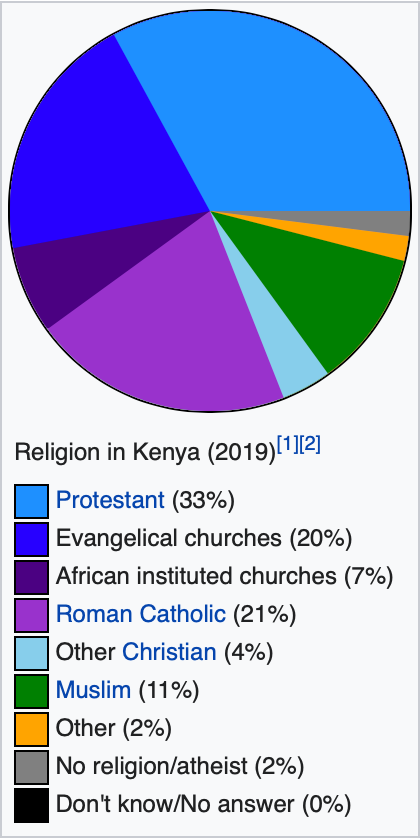
The main religion people identify as is Christian, making up roughly 85.5% of the population. 60% of the 85.5% are Protestant, 23% being Catholic and the remainder identify as another branch of Christianity.
The second largest religion in the country is Islam, making up roughly 10.9%, the majority of the group are Sunni.
Other religions found across the country include, Hinduism making up 0.13% of the population, Buddhism, with less than 1000 Buddhists in the country and Baháʼí Faith, which consists of around 1% of the population.
1.6% of the population claim to follow no religion.
Traditional African religions are typically based on natural phenomena and reverence to ancestors. The dead are presumed to transform into another state of being and capable of bringing good fortune or calamity to the living.
Most religious rites are centred on appeasing the dead through sacrifices and proper burial rites.
Followers of traditional Kikuyu religion believe Ngai resides on Mount Kenya and say their prayers facing the mountain.
Followers of traditional Mijikenda religion have their holy shrines in the forests where they offer sacrifices and pray.
The Maasai, Turkana, Samburu and Pokot tribes also have significant numbers of persons adhering exclusively to traditional African religions.
Music and Dance
Music and dance in Kenya is an artistic expression which has been passed down throughout history as well as a way to communicate and bring people together. Dancers can be found dressed in costumers, wearing masks and even carrying shields, and music can be categorised into these groups: Lullabies, initiations, children's songs, marriage and burial dirges, hero praises, preparing the land, planting and harvesting, criticism and condemnation and more. To accompany dances an array of instruments are used including percussion and drums.
A Video of the Maasai Tribe singing and dancing;
The Top 5 dances throughout Kenya include;
The Maasai community in Kenya celebrates several unique traditional ceremonies, one of which is the Eunoto. The ceremony is performed by members of the same age group 10 years after they are initiated in to adulthood. The ceremony is marked by a unique Maasai traditional dance called “Adumu.”
Mwomboko dance is one of the most common traditional dances among the Agikuyu people, the largest ethnic group in Kenya. The dance is usually performed during historic events, such as Madaraka Day, which commemorates the day Kenya gained internal self-rule from the British colonizers.
Isikuti is a popular traditional dance practiced by the Isukha and Idakhoclans of the larger Luhya community. It’s a fast-paced and energetic dance, involving both men and women. The dance is characterized by the vigorous shaking of the shoulders and waist and rhythmic stamping of the feet.
The Chakacha dance is very common in the Kenyan coastal region, which is predominantly occupied by Swahili people. This traditional dance is usually performed and watched by women.
Kilumi is a traditional drum song and dance performed by women from the Kamba community. The dance is comprised of twokilumi drums that are accompanied by ululations and singing of the lead singer who is usually backed by two or more other women vocalists. The drummers sing too. A single session of Kilumi dance can last about half an hour.
The National Food
The national food of Kenya is Ugali
Ugali is a dish made of maize flour, though it's sometimes made out of millet or sorghum flour. It's made by adding the maize flour to boiling water until you get a dough-like consistency.
The dish is usually served alongside grilled meat and salsa and can be made using the following recipe; https://ingmar.app/blog/recipe-the-national-dish-of-kenya-ugali-nyama-choma-na-kachumbari/
Ugali
1 l water
320 g maize flour
Kachumbari
350 ml warm water
½ tsp salt
2 onion
3 tomatoes
200 g coriander leaves
1 tbsp lemon juice
Nyama Choma
350 ml warm water
1 tsp salt
1 leg of goat preferably a back leg
1 rack of goat ribs
INSTRUCTIONS Ugali
Place the water in a pot on high heat.
Once the water gets warm, add half the amount of cornflour and stir it. Continue to stir until it thickens and becomes porridge. When you start seeing bubble, cover the pot and leave it to cook for 4 minutes on medium heat.
Remove the pot from the heat and add the rest of the cornflour. Stir it. As you mix in the rest of the cornflour it will become harder, almost like play dough, continue to mould it until all the flour is mixed in, and mash all the lumps.
Then spread it flat at the bottom of the pot as much as possible, cover, and put back on the fire on medium heat.
After 4 minutes, open and stir it up in order to turn it, and spread it back on the bottom, cover, and put back on the heat. Repeat twice.
Mould it in the middle of the pot into a nice round shape, and place on a serving dish.
Kachumbari
Slice the onion and soak it in 350 ml warm water with ½ teaspoon salt for 20 minutes to reduce bitterness
Slice the tomatoes
Once the onions are done soaking, drain them, then combine with the tomatoes and chopped coriander, finally adding the lemon juice.
Nyama Choma
Get a good charcoal fire going on your grill.
Stir 1 teaspoon salt into 350 ml warm water for sprinkling on the meat.
Place the rack of ribs and leg on the grill. Make some diagonal cuts on either side of the leg, about a centimetre deep.
Monitor and turn both pieces regularly to ensure even cooking. Allow them to brown evenly.
Occasionally sprinkle with salty water to keep from drying.
Once cooked to medium, sprinkle generously with salty water and wrap them in foil. Make sure the foil is well sealed, with no holes.
Place them back on the grill (in the foil) to continue cooking for 45 minutes to 1 hour. The meat will steam inside the foil as it continues to cook and will remain soft and moist.
When ready, unwrap, separate the ribs and cut the leg into bite-sized pieces for serving.


Comments